Tuesday, April 30, 2013

A Stand Still

   Very recently, it was released that Professional basketball player, Jason Collins, has come out and publicly announced that he is gay. Although being gay is extremely more commonly accepted in our society today than it used to be, this was seen as a huge turning point in the progress of American History just because Collins was the first professional basketball player to have ever come out, and one of the very few professional athletes to have come out in general. However, can it really even be recognized as a huge spike in the progress we've made in this nation?
   In the CNN article further announcing Collins's coming out, they describe the large amounts of praise he received from people all over the country, including a congratulatory call expressing "support" and a feeling of "being impressed" by someone as recognizable as President Obama. I agree that yes, all this support and praise for Collins is amazing and really shows just how acceptable our society CAN be. However has it really made the progress we think it's made? The article discusses further that one of the reasons Collins decided to come out was because of the Boston Marathon bombing, and to live in complete honesty because something could happen like that any second. He also claimed he wished someone could've "already done this"so it'd be easier, but because that's not the case he decided to.
   These examples further illustrate the idea that in actuality not much progress has been made at all, and makes me question if there are many other athletes who are like Collins, and still don't feel completely comfortable enough to be the person seen as "different" and come out. Because there are so few athletes who have come out, that emphasizes the doubt I truly have for this progress as well. Because if the few that have actually come out however admitted that they still did feel uncomfortable and wish someone else had done it before them, I would imagine there may be others feeling the same way of still not completely being accepted in to our society.
   What do you think? To what extent do you believe this progress we claim to be making is actually real? Do you feel as though things haven't been making the progress people believe it has or want to believe it has? Do you feel that these imaginary lines separating certain kinds of people from eachother still exist? Comment below.

Wednesday, April 24, 2013

An Unreachable Dream

   As we are finishing up the novel The Great Gatsby a particular parallel I took notice of and thought was important in order to understanding the book was the image of the green light at the end of Daisy's dock that Gatsby always is looking longingly at. To me I saw this as representing Gatsby's hope and dreams for the future. As it lights up in the dark, I saw it as what ultimately guided Gatsby through the darkness as a guide light for hope and safety. And ultimately for him, this future reflected through the green light he hoped so much for and waits patiently for for so long is just representing Daisy. Many think that it's the idea of her he loves, however, personally I think when you wait for someone for that long and you've liked them through even your child hood it must be actual love, and not artificial. Also because I think this green light symbolizes the hope Gatsby has for Daisy, the idea that she's almost guiding him through the darkness seems genuine to me. However don't get me wrong, I 100% believe that Daisy isn't exactly only in it for the love but for the money just because Fitzgerald has portrayed her as someone who has become so demoralized by the idea of wealth and power. However, because Gatsby is so self made and he worked to become what he is now, he isn't some artificial person like Daisy.
   I also think that the green light is ultimately standing for the American Dream because Gatsby's quest for Daisy is so closely related to it. In a line on the very last page of the book this is further illustrated, "Gatsby believed in the green light, the orgastic future that year by year recedes before us. It eluded us then, but that's no matter-- tomorrow we will run faster, stretch out our arms farther.... and then one fine morning-- so we beat on, boats against the current, born back ceaselessly in to the past."Here I read it as how the American Dream is reflected through the situation Gatsby has with Daisy. For all Americans, if you believe in something so much and always have some kind of hope or dream in it no matter what it is, in this case it's something you're wishing for in the future that's happened in the past (Daisy and Gatsby being together), if you keep on trying harder and harder for it, according to the American dream you should find success; however, in this case the idea of the American dream has been demoralized and decayed so much by the greed of wealth in the book that it's saying no matter how hard you tryyou'll keep trying however you won't be going anywhere "your boat" will be "going against the current" very unproductively and will be caught up in the past and not moving on in to the future. Which is what happened with the aspired dream Gatsby always held for Daisy.
   What do you think about this? Does this theme commonly come up today in American society? Do we seem to be stuck in some kind of cycle and not moving on from things in the past, or making mistakes that have been echoed in the past?

Tuesday, April 16, 2013

Dark Echoes of the Past

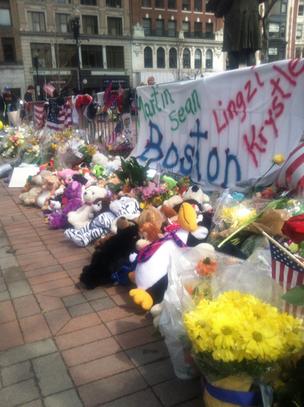
   Like 9/11, April 15th, 2013 will be another date in American history that will never be forgotten. The bombings on that day during the Boston Marathon were able to not only destroy the lives of many people physically, but also emotionally, as horrific events and unwanted emotions from September 11th seemed to resurface back into our nation.
   As the article from CNN linked above says, "if September 11th, 2001, was the day our innocence was taken, then April 15th, 2013, is the reminder that it is never coming back."To me, in this quote, the meaning of "innocence" they are referring to is characterizing America as having ignorance and a lack of knowledge that the possibility of something as terrible and threatening as 9/11 could happen to a nation as powerful as them. It's saying that although this chosen ignorance was initially taken away after 9/11 occurred, if for some reason Americans still thought or chose to believe that something as terrible could never happen to a country like them again, the Boston bombings should've entirely stripped them from those feelings and given a "new reality" where "it can't happen here" is brutally replace by "it can happen anywhere" (CNN), including the United States. So, in reality this great sense of American pride that every citizen shares seems to slowly be decaying as the ignorance of being thought of as untouchable is being replaced by a sense of newfound paranoia.
   This paranoia I feel like eventually brings out negative values. Although I strongly agree that these kind of tragic events do bring our nation closer together and "unite" us, they also will cause distance and mistrust between each other. For example, since 9/11 and it is now further seen through the Boston bombings, people tend to alienate and become suspicious of certain groups of people in our country, specifically American Muslims. In a Huffington Post article, it describes an American Muslim child where a deep, building sense of "fear of guilt by bogus association is embedded". It says that when these events of terrorism occur, another "layer of fear" is added on, the fear that "they will be blamed" and looked at differently.
   After reading this I really began to question this constant notion of "progress" our nation claims to be making, and saw a decline of fundamental American values seen through the American Dream. People come to America because they think that they will find better opportunity and equality. However, the fact that this specific group of people actually feels the opposite and unequal toward who they thought of as fellow Americans contradicts the idea of progress as a nation as well as the values we take pride in as Americans. What do you think? Has this sense of paranoia built up in our nation created stronger invisible lines between groups of people? To what extent have American values been overlooked at and the search for the American dream seem more like a myth in times like these? Comment below.

Thursday, April 4, 2013

The Lollapalooza Quest

    I think it was a few weeks ago in class when we had the short discussion on what people really went to Lollapalooza (the music festival in Chicago) for. Mr. O'Connor questioned the percentage of people who actually went to the event for it's purpose, to go for the music... versus the number of people who just went to say they went there, or went because they saw it as more of a social scene rather than a place to appreciate your favorite musicians. 
    Coincidentally, the sale for a regular 3 day pass happened to come out this week, on April 1st. Since I have been a regular goer to Lollapalooza for the past couple years, I had been waiting in great anticipation for this day this entire year. However, things went a little differently. 
    How the sale of these tickets work is that first there are two very early rounds of 3 day passes that sell to the very lucky people for a ton cheaper than regular price, however are impossible to get because of the incredibly small amount of them. And then, a couple weeks later, the regular priced one day and three day passes come out. For these regular priced tickets, obtaining them has never been an issue, as they usually don't sell out until a about a month after they first come out. However as I was saying, for some reason this year, you were considered one of the lucky ones if you managed to get your hands on a regular 3 day pass, or even if you managed to get the one days. I'm not exaggerating when I recount just how impossible it was to get them this year: They sold out in less than the first 3 hours of release, all of them. It was one of the most unexpected things that's ever happened. So then I had to go on Stub Hub in order to purchase a 3 day pass which was just over the top expensive.
    However, this really made me question what was so different about this year than previous years? What kind of people are buying all these tickets? Is it just the two groups of people Mr. O'Connor brought up, or is it maybe another kind trying to buy in bulk and make a profit?
    Through these groups of people we are able to see certain American values reflected. For example, for those who buy in the bulk, their main concern is the pursuit for the American dollar. Additionally by doing this, they will ultimately find contentment through this newfound wealth and feeling of success after eventually making a profit from others. Or for the people who go there merely for the social scene, their version of success is buying this ticket and ultimately accomplishing the goal of being able to say they went.
    Do you see this key principle of the American Dream, hard work and doing whatever it takes to succeed, relate to what has been going on here in some sense? To what extent do you see this occurring if so? Why do you think there was this sudden incredible spike in the demand for tickets? Comment below.
   

Monday, April 1, 2013

A BIG, FAT, Shocking Issue


 While researching for my junior theme, on the subject of why has there been a rise in eating disorders in our society today, I came across a very shocking piece of evidence that helped support my claim on why changes in the media and advertising in Western society I thought have contributed the most to the rise. The piece of evidence I found was a study done on girls on Fiji's main island after the introduction of American television. In the article, it tells us that in Fijian culture, being bigger as a women was what was looked at as attractive and the "ideal" look. However, after the introduction of American television this completely changed and the ideal bigger look that had been apart of Fijian society for years was completely forgotten in a matter of days. It was replaced by what girls in Western society believe to be ideal, the frame of a girl who is extremely below average in weight. It was reported that girls on the island started worrying about their weight and body image, and eating disorders which weren't ever heard of before started to rise and come up... dramatically. 
   The influence this unrealistic image American media constantly advertises clearly must have a huge roll and impact on the amount of eating disorders that have risen today. Because of the easier access people have to social media through technology they are constantly being exposed to this image. And if it has the power to change a societies traditional ideal looks in a matter of weeks of first being introduced it must be pretty powerful, especially for girls like in Western society who have been exposed to it everyday since they were born.
   Why do you think the media continues to advertise this unrealistic ideal body even after research has been done and it's been proven that it has such a negative affect on women everywhere? To what extent do you feel as though reaching perfection and success is seen as an American value and is reflected in the current issue today?